
WhatsApp chat
Skip to main content
Legal Entity Identifier Services hero background

Legal Entity Identifier (LEI) Registration in Singapore with a GLEIF-Accredited LOU

Apply for your Legal Entity Identifier in Singapore through TNV-LEI, a GLEIF-accredited Local Operating Unit authorised to issue and maintain LEIs for Singapore-registered entities. TNV-LEI issues 20-character LEI codes under ISO/IEC 17442 and operates under externally audited governance supported by ISO 9001, ISO/IEC 27001, SOC 2 Type II independent attestation by Ken & Co. (USA), and independent VAPT conducted at least annually. Singapore entities can also use TNV-LEI to renew an existing LEI or LEI transfer its management from another provider.

GLEIF Accredited Badge
  • GLEIF-accredited LOU — effective 10 October 2025; Singapore (SG) within accreditation scope

  • Pricing in SGD (S$); GST itemised separately on the invoice where applicable

  • ISO 9001-certified QMS; ISO/IEC 27001-certified ISMS

  • SOC 2 Type II independent attestation conducted by Ken & Co. (USA)

  • Independent VAPT — annual cadence minimum

  • Validation against Accounting and Corporate Regulatory Authority (ACRA)

  • Two Executive Directors; three Independent Directors of national standing — including a former Reserve Bank of India Chief General Manager (Department of Regulation) with FATF plenary experience

LEI Cost for Registration and Renewal

Singapore Jurisdiction Overview

Quick Facts — Singapore

A quick overview of Singapore’s key regulatory, currency, and business details. Use this summary to understand the local jurisdiction before exploring the LEI information below.

REGULATORY

MAS

CURRENCY

SGD (S$)

FieldValue

Country

Singapore

ISO 3166 code

SG

Operational status

OPEN OFFERING — TNV-LEI authorised for issuance

Languages

English (administrative); Mandarin, Malay, Tamil

hreflang

en-SG (primary) + x-default

Pricing currency

SGD (S$)

Local tax

GST

Primary corporate registrar

Accounting and Corporate Regulatory Authority (ACRA)

Primary financial regulator

Monetary Authority of Singapore (MAS)

Other regulators

Principal exchange

Singapore Exchange (SGX)

Clearing / settlement infrastructure

Central Depository (Pte) Limited (CDP); SGX-CCP

Trade repositories used

DTCC Data Repository (Singapore) Pte Ltd

Data-protection regime

Personal Data Protection Act (PDPA)

Privacy authority

Personal Data Protection Commission (PDPC)

AML supervisor

MAS; Suspicious Transaction Reporting Office (STRO)

Tax authority

Inland Revenue Authority of Singapore (IRAS)

Pension regulator

Central Provident Fund (CPF) Board

Built for Singapore entities applying, renewing or transferring LEIs through TNV-LEI.

Apply for LEI
  • Is an LEI mandatory for Singapore entities?

    Whether an LEI is required in Singapore depends on the entity’s activities and reporting obligations. Singapore entities subject to reportable derivatives transactions may need an LEI for counterparty identification and regulatory reporting under the Securities and Futures reporting framework.

  • Who issues LEIs in Singapore?

    GLEIF-accredited Local Operating Units (LOUs) issue LEIs in Singapore. TNV-LEI is a GLEIF-accredited LOU authorised to issue LEIs to Singapore-registered legal entities. Verify our status at the GLEIF public list of LEI Issuing Organizations at gleif.org.

  • How much does an LEI cost in Singapore?

    The LEI cost in Singapore depends on the registration or renewal term selected. TNV-LEI pricing is shown in SGD (S$), with multi-year terms available for 3 or 5 years. GST is itemised separately on the invoice.

  • What happens if my Singapore LEI lapses?

    A lapsed LEI status shows that the LEI record has not been renewed by its renewal date and may affect regulatory reporting or financial workflows that require current LEI data. Completing LEI renewal in Singapore restores the record to Issued status.

  • How long does LEI registration take in Singapore?

    Standard LEI registration in Singapore typically completes within one business day after payment and successful validation against Accounting and Corporate Regulatory Authority (ACRA) records. Fast-Track issuance in 2 to 4 UK working hours is available, subject to data completeness, applicant authority and successful validation.

  • Can a foreign entity get an LEI for its Singapore subsidiary?

    Yes. Eligibility is determined by where the entity is registered, not where its parent is registered. A subsidiary registered in Singapore is eligible for an LEI from TNV-LEI under our GLEIF accreditation.

  • Does a TNV-LEI Singapore LEI work in other jurisdictions?

    Yes. The LEI is a global identifier under ISO/IEC 17442. An LEI issued by TNV-LEI for a Singapore-registered entity is recognised in every regulatory regime that uses the LEI worldwide — including the EU, UK, US, Australia, Singapore and others.

  • Can a Singapore entity transfer an existing LEI to TNV-LEI?

    Yes. An LEI transfer in Singapore allows under GLEIF policy, transferring an existing LEI from another GLEIF-accredited LOU to TNV-LEI is free of charge. The 20-character LEI code does not change; only the managing LOU changes. Transfers typically complete within seven business days.

GLEIF-accredited LOU

TNV-LEI is a GLEIF-Accredited LEI Issuer

Under the Global Legal Entity Identifier System, LEI codes are issued by GLEIF-accredited Local Operating Units (LOUs) and their authorised representatives.

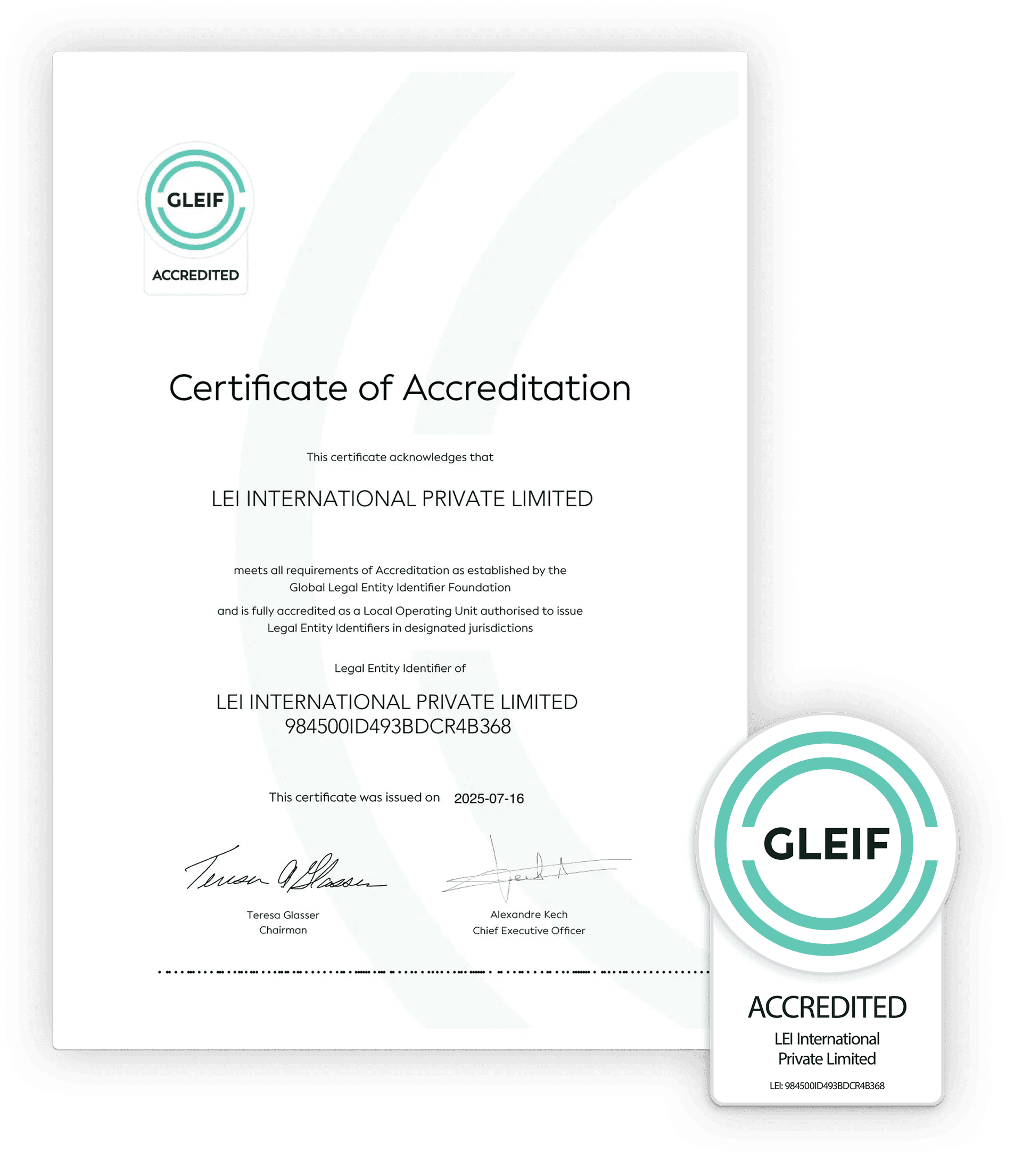
TNV-LEI holds GLEIF accreditation as a Local Operating Unit, effective 10 October 2025, and is authorised by GLEIF to issue and maintain Legal Entity Identifiers across 26 approved jurisdictions, including Singapore.

TNV LEI Accreditation Certificate
  • Accredited by GLEIF, effective 10 October 2025
  • Validation performed in-house under our LOU accreditation
  • LEIs issued carry our GLEIF-assigned LOU prefix
  • Full lifecycle management: issuance, renewals, transfers, amendments and lapse handling
  • Client communication handled by our UK support team
  • Authorised representatives may submit applications on behalf of clients under our LOU accreditation

TNV-LEI accreditation can be verified on the official GLEIF website list of accredited LEI issuing organisations.

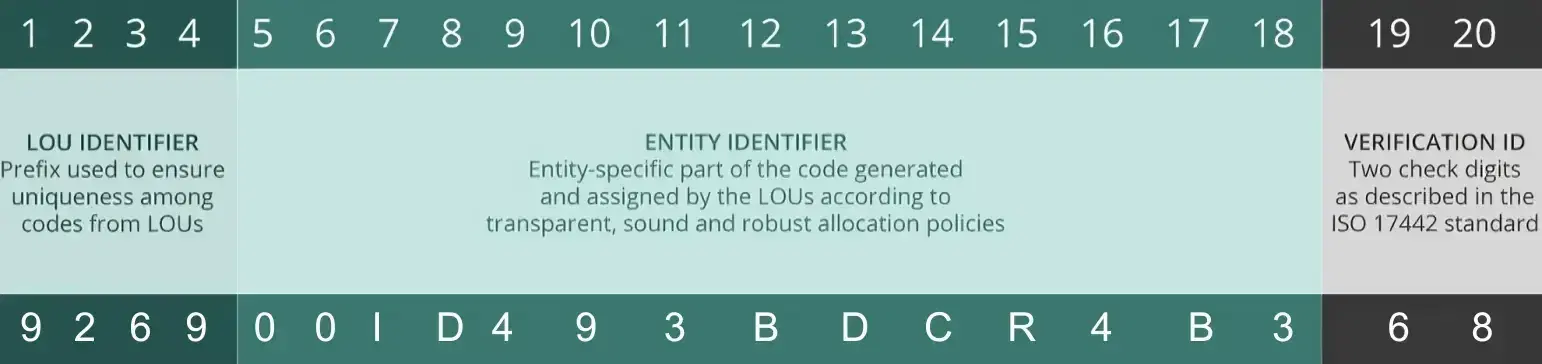
ISO/IEC 17442 Identifier

What is a Legal Entity Identifier (LEI)?

A Legal Entity Identifier (LEI) is a 20-character alphanumeric code that uniquely identifies a legal entity participating in financial transactions. In Singapore, the LEI Number appears across MAS derivatives reporting, SGX issuer reference data, bank onboarding, risk management and cross-border counterparty workflows.

What is a Legal Entity Identifier (LEI)?

20 characters

Format

Alphanumeric code under ISO/IEC 17442.

Global

Scope

Recognised across financial markets.

GLEIF

System

Published in the GLEIF Global LEI Index.

Reporting ready

Singapore Use

Used by MAS, SGX, banks and counterparties.

In short

It is issued only by GLEIF-accredited Local Operating Units such as TNV-LEI and is used by regulated counterparties, banks, brokers and reporting systems in Singapore and globally.

Regulatory Intelligence

Country-Specific Regulatory Intelligence — Where the LEI Surfaces in Singapore

This section names the specific statutes, reporting frameworks, and supervisory engagement that drive the LEI requirement in Singapore. Verify against Monetary Authority of Singapore (MAS) and other named authorities' current publications before publication.

Statutes referencing the LEI (directly or by reporting linkage)

Statute / RegulationLEI linkageVerification source

Securities and Futures Act (SFA)

MAS securities and derivatives framework

Monetary Authority of Singapore (MAS)

Variable Capital Companies Act 2018

Singapore VCC fund-vehicle framework

Monetary Authority of Singapore (MAS)

Banking Act

MAS banking framework

Monetary Authority of Singapore (MAS)

Insurance Act

MAS insurance framework

Monetary Authority of Singapore (MAS)

Corruption, Drug Trafficking and Other Serious Crimes (Confiscation of Benefits) Act (CDSA)

Singapore AML framework

Monetary Authority of Singapore (MAS)

Reporting frameworks — LEI obligations in Singapore

FrameworkLEI provisionReporting systemEntities in scope

MAS SFA OTC Derivative Reporting

LEI mandatory for both counterparties

DTCC Data Repository (Singapore)

OTC derivatives — IR, FX, credit, equity, commodity

MAS Notice 637 / 1015 prudential reporting

LEI counterparty identification

MAS platforms

Bank prudential reporting

SGX Listing Rules

Issuer LEI for cross-border investor identification

SGX

Listed equity, debt, and structured products

MAS Fund Reporting Requirements

LEI for fund identification

MAS platforms

Singapore funds incl. VCCs

Global Identity Infrastructure

Benefits of an LEI for Singapore Entities

A valid, renewed LEI gives a Singapore entity a globally recognised identifier that can support MAS regulatory reporting, entity verification, bank and broker onboarding, and cross-border counterparty identification.

Trust Signal

One active LEI gives Singapore reporting systems, banks, brokers and counterparties a verified signal to rely on.


Regulatory readiness

Supports MAS OTC derivatives reporting workflows under Singapore’s Securities and Futures reporting framework where LEI fields apply.

Bank and broker onboarding

Helps Singapore banks, capital markets intermediaries and cross-border counterparties verify the legal entity before reportable activity.

Cross-border entity identification

Provides one consistent identifier for a Singapore entity when dealing with financial institutions, counterparties and payment systems across different markets.

Better transparency and reference data

Connects the entity to publicly available LEI reference data, helping counterparties confirm key legal-entity information and reduce ambiguity.

Singapore Eligibility Guide

Why Your Singapore Entity Type Needs an LEI

The reason a Singapore entity needs an LEI is specific to its legal form and its activity. The paragraphs below explain — for each common Singapore entity type — the specific regulatory trigger, the specific counterparty-driven trigger, and the specific consequence of not holding an active LEI.

Entity type

Private Company Limited by Shares (Pte. Ltd.)

The need for an LEI arises when the Private Company Limited by Shares (Pte. Ltd.) engages in reportable financial activity — typically a derivative transaction with a bank, a securities issuance, supervisory reporting by Monetary Authority of Singapore (MAS), or onboarding by a counterparty that requires LEI identification.

Apply for this LEI
Eligibility
Yes — most common Singapore form.
Validation source:
ACRA.
Evidence required:
M&AA; UEN; signing authority.

Consequence of LEI absence or lapse:

counterparty may decline trades; supervisory reporting may be rejected; onboarding may pause until an active LEI is in place.

Industry Intelligence

Industry Landing Intelligence — 7 Singapore Industry Sub-Sections

LEI for MAS-Licensed Singapore Capital Markets Services Holders

MAS-licensed Capital Markets Services (CMS) licence holders require LEI for MAS OTC derivative reporting under SFA.

Regulatory trigger: Securities and Futures Act; MAS OTC Derivative Reporting.

Operational trigger: DTCC DR (Singapore) validates LEI at submission.

TNV-LEI value: SOC 2 by Ken & Co. (USA); ISO/IEC 27001 — MAS Technology Risk Management Guidelines (TRMG) expectations.

CTA: MAS CMS holder LEI

LEI for Singapore Variable Capital Companies (VCCs)

Singapore VCCs — the dominant new Singapore fund vehicle since 2020 — require LEI at fund (or sub-fund) level for cross-border counterparty identification.

Regulatory trigger: Variable Capital Companies Act 2018; AIFMD / UCITS for cross-border distribution.

Operational trigger: Investment manager identifies VCC (or sub-fund) as counterparty.

TNV-LEI value: Bulk pricing for VCC umbrella structures with multiple sub-funds.

CTA: Singapore VCC LEI

LEI for MAS-Supervised Singapore Banks

MAS-supervised Singapore banks require LEI for MAS OTC derivative reporting and cross-border correspondent banking.

Regulatory trigger: Banking Act; MAS Notice 637; MAS OTC reporting.

Operational trigger: MAS reporting platforms validate LEI.

TNV-LEI value: Established Singapore bank LEI workflow.

CTA: Singapore bank LEI

LEI for SGX-Listed Singapore Issuers

SGX Main Board and Catalist-listed Singapore issuers require LEI for cross-border investor identification.

Regulatory trigger: SGX Listing Rules.

Operational trigger: Issuer reference data includes LEI.

TNV-LEI value: Independent attestation discipline for Straits Times Index vendor selection.

CTA: SGX issuer LEI

LEI for Singapore Family Offices and Wealth Managers

Singapore family offices and MAS-licensed wealth managers require LEI for cross-border counterparty exchange.

Regulatory trigger: Securities and Futures Act; MAS Wealth Management Industry Code.

Operational trigger: Wealth-management trades cross multiple jurisdictions; LEI travels with trade.

TNV-LEI value: Established wealth-management LEI workflow.

CTA: Singapore family office LEI

LEI for Singapore Insurance and Reinsurance Companies

MAS-supervised Singapore insurers and reinsurers require LEI for cross-border reinsurance counterparty identification.

Regulatory trigger: Insurance Act.

Operational trigger: Reinsurance treaty counterparty identification.

TNV-LEI value: Lifecycle management for Singapore reinsurance hub entities.

CTA: Singapore insurance LEI

LEI for Singapore Corporate Treasury Centres

Singapore corporate treasury centres (substantial multinational hub function) require LEI for cross-border hedging and group treasury operations.

Regulatory trigger: MAS OTC reporting; EU EMIR REFIT for European counterparties; CFTC Part 45 for US counterparties.

Operational trigger: Treasury centre hedging operations require LEI.

TNV-LEI value: Multi-year terms; coordinated regional renewal.

CTA: Singapore treasury centre LEI
Eligible Legal forms

Singapore Legal Forms Eligible for an LEI

Singapore Legal Forms Eligible for an LEI, with validation source and documents

Form (native + gloss)Eligibility under ISO/IEC 17442Validation sourceDocuments required

Private Company Limited by Shares (Pte. Ltd.)

Yes — most common Singapore form

ACRA

M&AA; UEN; signing authority

Public Company Limited by Shares (Ltd.)

Yes — including SGX-listed

ACRA + SGX

M&AA; UEN; listing

Variable Capital Company (VCC)

Yes — Singapore fund vehicle since 2020

ACRA VCC register

Constitution; UEN; investment-manager authority

Limited Liability Partnership (LLP)

Yes — Singapore LLP

ACRA

LLP agreement; UEN; partner authority

Limited Partnership (LP)

Yes — Singapore LP

ACRA

LP agreement; GP authority

Trust (Singapore unit trust; family trust)

Yes — at trust level where commercially active

MAS register / trust deed

Trust deed; trustee authority

Bank licensed by MAS

Yes — MAS-supervised

MAS register + ACRA

MAS licence

Insurance Company (MAS-licensed)

Yes — MAS-supervised

MAS register + ACRA

MAS insurance licence

Reporting WorkFlow

Regulatory Reporting Intelligence — Where the LEI Surfaces in Singapore Reporting Workflows

In Singapore, the LEI appears as the counterparty identifier across the following reporting workflows:


  • MAS SFA OTC Derivative Reporting — LEI mandatory for both counterparties. Reported to: DTCC Data Repository (Singapore).
  • MAS Notice 637 / 1015 prudential reporting — LEI counterparty identification. Reported to: MAS platforms.
  • SGX Listing Rules — Issuer LEI for cross-border investor identification. Reported to: SGX.
  • MAS Fund Reporting Requirements — LEI for fund identification. Reported to: MAS platforms.
Singapore Market Economy

The Singapore Financial Ecosystem

The Singapore financial ecosystem, including venues, clearing, fund terminology, regulatory vocabulary, pension terminology and operational pain points.

Exchanges and trading venues

Singapore Exchange (SGX) — Main Board and Catalist; Straits Times Index (STI) leading benchmark

Clearing and settlement

Central Depository (Pte) Limited (CDP); SGX Derivatives Clearing (CCP); SGX-DC

Native vehicle and fund-structure terminology in Singapore

Variable Capital Company (VCC) — dominant new fund vehicle since 2020; Limited Partnership; REIT (S-REIT); Authorised Schemes; Restricted Schemes

Regulatory terminology

MAS Notice; MAS Guideline; MAS Circular; MAS FAQ; MAS Regulation

Pension system terminology

Central Provident Fund (CPF); Supplementary Retirement Scheme (SRS); private pension less developed

Treasury and corporate finance terminology

Treasury; SGD FX management; SIBOR transition (now SORA); regional treasury centre operations

Common operational pain-points for Singapore entities

Singapore VCC adoption has been substantial since 2020 — VCC sub-fund LEI distinction from umbrella LEI is a common source of confusion; Singapore as a regional treasury centre requires LEI for both Singapore entity and group entities; MAS technology risk management standards apply to LEI service-provider arrangements

Risk in Inactive LEI

What Happens Without an Active LEI in Singapore?

When a Singapore entity enters a financial, reporting, or counterparty workflow that requires an active LEI, a missing or lapsed LEI creates practical delays. The impact depends on the transaction or reporting framework involved.

Regulatory reporting interruption

Where a Singapore regulatory reporting workflow requires an LEI, the reporting entity needs a valid identifier for the relevant counterparty fields. A missing or inactive LEI creates a reporting issue that must be corrected before the required entity information can be submitted accurately.

Onboarding delay

Singapore banks' onboarding workflows typically include an LEI check at the point of opening a derivative-trading or investment-services account. Without an active LEI, onboarding cannot complete. Treasurers routinely experience delays of weeks.

Cross - border counteryparty rejection

Singapore entities trading with counterparties subject to EU EMIR REFIT, UK EMIR REFIT, CFTC Part 45 or other regimes may be refused by the counterparty whose reporting obligations require both sides to have an active LEI.

Issuance pipeline blocking:

Listed-issuer activities (new ISIN issuance, secondary offerings) often require an active LEI at the relevant CSD or trading-venue layer.

Supervisory follow-up risk:

Recurring LEI-related reporting failures attract supervisory engagement from Monetary Authority of Singapore (MAS) and increase the operational-risk footprint of the regulated firm.

Five Step Online Process

How to Register an LEI in Singapore — 5-Step Process

The LEI registration process in Singapore with TNV-LEI is completed online in five clear steps, from submitting entity details to final validation and LEI issuance. Standard issuance typically completes within one business day after payment and successful validation, while Fast-Track issuance is available in 2 to 4 UK working hours for complete and unambiguous applications.

Standard issuance

Within 1 business day

after payment and successful validation.

Fast-track issuance

2-4 working hours

Where the application is complete and unambiguous.

  1. 01

    Complete the Online LEI Application

    Provide the entity's exact legal name as registered in Accounting and Corporate Regulatory Authority (ACRA), the national registration identifier, registered address, parent-relationship information where applicable, and authorised-signatory contact details.

    Parent relationships are required for Level 2 LEI data (ultimate parent and direct parent) unless a recognised GLEIF reporting exception applies.

  2. 02

    Provide Supporting Documents Where Required

    For most Singapore corporate applications, the registrar record is sufficient. Trusts, funds, partnerships and branches require additional governing documents.

    TNV-LEI validates directly against the Accounting and Corporate Regulatory Authority (ACRA) record without requesting further evidence wherever the registry data is clear.

  3. 03

    Letter of Authorisation

    An authorised signatory signs electronically.

  4. 04

    Complete Payment

    Pay in SGD via card or bank transfer. GST-itemised invoice generated automatically.

  5. 05

    Validation against Accounting and Corporate Regulatory Authority (ACRA) and issuance

    TNV-LEI validates against the authoritative Singapore register. The 20-character LEI Number is issued, published in the GLEIF Global LEI Index, and the certificate is emailed.

Avoid Common Delays

If TNV-LEI identifies an inconsistency between the application and the public registry, the applicant is contacted with a specific list of items to confirm or correct. The most common reasons for delay are: Name mismatch Missing parent-relationship information Unclear applicant authority None of these issues require new fees — they only require the correct data.

After Issuance

Your LEI must be renewed annually. TNV-LEI sends renewal reminders 60, 30 and 7 days before lapse.

You can also opt for a 3-year or 5-year term to reduce renewal administration.

Country-tailored differentiation

Why TNV-LEI for Singapore Entities

Each TNV-LEI differentiator below is tied to a specific value proposition for Singapore entities:

Direct Accreditation

Direct GLEIF accreditation: For Singapore entities subject to Monetary Authority of Singapore supervision, TNV-LEI's direct GLEIF accreditation provides the unambiguous lineage the supervisor expects from an entity-identifier provider.

Certified Governance

ISO 9001 + ISO/IEC 27001 certification: Singapore regulated firms and treasury teams require evidence of certified quality and information-security management before adding identifier providers to approved-vendor lists.

US-Recognised Attestation

SOC 2 Type II independent attestation conducted by Ken & Co. (USA): For Singapore subsidiaries of US corporate parents, this US-recognised attestation standard provides the assurance the US parent's compliance function requires when reviewing the Singapore entity's vendor selection.

Penetration Testing

Independent VAPT: Singapore-domiciled regulated entities under Personal Data Protection Act (PDPA) routinely require evidence of penetration testing by service providers handling personal data of authorised signatories.

Independent oversight

Three Independent Directors: For Singapore entities, Independent Directors of national standing in banking regulation (former RBI CGM with FATF plenary experience), defence-PSU governance (former MD of HAL Maharatna), and engineering excellence (former GM of ICF Chennai; FIMechE) provide the governance assurance the Singapore supervisory culture expects.

Predictable Speed

Fast-Track 2–4 working hours subject to qualifier: Predictable issuance timeline for time-sensitive scenarios.

Review Cadence and Transparency

Quarterly compliance review of every published page; documented challenge process.

Entity Relationships - Knowledge Graph

Knowledge Graph — Singapore LEI Regulatory Ecosystem

The core entity-to-entity relationships that map the Singapore LEI regulatory ecosystem.

Entity (subject)RelationshipEntity (object)

Singapore

is supervised by

MAS

Singapore

has corporate registrar

ACRA

Singapore

has principal exchange

Singapore Exchange (SGX)

MAS

administers

Securities and Futures Act; Banking Act; Insurance Act; VCC Act

MAS

supervises

Singapore banks; investment firms; insurers; VCCs; fund managers

DTCC Data Repository (Singapore)

receives

Singapore OTC derivative trade reports

CDP

provides

Singapore CSD services

VCC

is governed by

Variable Capital Companies Act 2018

TNV-LEI

is authorised for

26 jurisdictions including Singapore

Renewal And Lifecycle

Renewal, Transfer and Lifecycle in Singapore

Renew annually. Transfer is free. An active LEI is the safest practical position for any Singapore entity engaged in regulated transactions.

Annual Renewal

Annual renewal under GLEIF rules. TNV-LEI sends reminders at 60, 30 and 7 days before lapse and on the renewal date.

Multi-year terms

Multi-year terms (3 or 5 years): eliminate the annual renewal workflow but still trigger GLEIF-mandated annual validation, performed by TNV-LEI at no additional charge.

Free LEI Transfer to TNV-LEI

Free LEI transfer to TNV-LEI under GLEIF policy. The 20-character LEI code remains unchanged.

What Happens if an LEI Lapses

Lapsed LEI: restored to Issued status immediately by completing renewal.

Other Lifecycle Events

Merger / dissolution / name-change / address-change / parent-change lifecycle events: reference data is updated; the LEI code itself is preserved or retired with reference to the surviving LEI.

LEIs are not deleted, only updated or retired in line with lifecycle events.

If your existing LEI is lapsed, transfer and renewal can be performed together so the LEI is active immediately upon transfer.

Global Identifier

International Recognition — Where a Singapore LEI Is Accepted

The LEI is a global identifier under ISO/IEC 17442. A Singapore LEI issued by TNV-LEI is recognised in every regulatory regime that uses the LEI worldwide, including:

European Union and EEA

EU MiFIR; EU EMIR REFIT; EU SFTR; EU CSDR; EU MAR; Solvency II

United Kingdom

UK MiFIR; UK EMIR REFIT; UK SFTR; FCA SUP 17A; Bank of England statistical returns

United States

CFTC swap reporting, including Part 45 and Part 46; SEC Regulation SBSR; FINRA reference data

Switzerland

FMIA (FinfraG) OTC derivative reporting

Australia

ASIC OTC Derivative Transaction Reporting Rules

Singapore

MAS OTC derivative reporting; SGX listed-issuer disclosure

Hong Kong

HKMA OTC derivative reporting; HKEX listed-issuer disclosure

Canada

CSA derivatives trade reporting; OSFI returns

Authority And Governance

Authority and Governance — Why It Matters for Singapore

Each Board member's expertise is mapped to a specific Singapore regulatory or operational context.

Mr. Pragyesh Kumar Singh

EXECUTIVE DIRECTOR AND PROMOTER

For Singapore Pte. Ltd. and Ltd. companies and SGX-listed corporates, Mr. Pragyesh Kumar Singh's Fellow ICSI standing and 25+ years across ISO management systems align with the governance discipline STI-listed issuers apply. MAS's emphasis on corporate-governance discipline (Singapore Code of Corporate Governance) makes this credential particularly relevant.

Mr. Ajeet Kumar

DIRECTOR AND DATA PROTECTION OFFICER

For MAS-supervised Singapore banks and family offices under PDPA data-protection regime, Mr. Ajeet Kumar's UK GDPR Article 37 DPO designation, ISO/IEC 27001 expertise, and 15+ years banking-and-certification experience map to PDPC enforcement expectations and MAS Technology Risk Management Guidelines (TRMG) requirements on third-party data-security arrangements.

Mr. Salil Kumar Jha

INDEPENDENT DIRECTOR

For SGX-listed Singapore corporates and Government-Linked Companies (GLCs) — Singapore's Temasek-portfolio governance — Mr. Salil Kumar Jha's Maharatna PSU MD experience and Independent External Monitor bank-supervisory experience provides directly relevant governance credential. Singapore Temasek-portfolio governance and India's Maharatna PSU framework share structural parallels.

Dr. Sudhanshu Mani

INDEPENDENT DIRECTOR

For Singapore infrastructure-sector corporates and engineering-corporate SGX issuers, Dr. Sudhanshu Mani's apex-grade engineering-delivery oversight provides relevant credential.

Mr. Santosh Kumar Panigrahy

INDEPENDENT DIRECTOR

For MAS-supervised Singapore banks subject to STRO AML engagement and FATF country evaluation, Mr. Santosh Kumar Panigrahy's FATF plenary representation, leadership of India's FATF country evaluation, and authorship of RBI Master Direction amendments on AML/KYC provide directly relevant central-bank AML credential. Singapore's substantive FATF engagement and Indo-Singapore central-bank cooperation make this credential particularly relevant.

Ready to apply, renew or transfer?

Whether you are applying for a new LEI for a Singapore-registered entity, renewing an existing LEI, transferring an LEI to TNV-LEI from another LOU, or facing an urgent deadline, our team is ready to help.

New Registration

Apply for Singapore LEI

Apply now

Existing LEI

Renew or Transfer

Renew/Transfer

Urgent Requirement

Fast-Track in 2-4 UK working hours

Fast-track

Need Help First

TNV-LEI Support Team

Contact Us
support@tnvlei.comMon-Fri 09:00-18:00 GMT/BST
Register Your LEI Number in Singapore | GLEIF-Accredited LOU